The flashpoint comes 81 days after the two sides signed a memorandum of understanding, a deal that has done little to slow the pace of military action at sea.
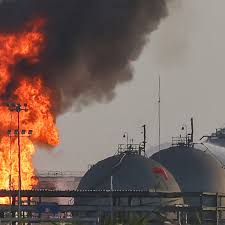
US Central Command confirmed that the tanker M/T Kylo had gone down in the Gulf of Oman following what it described as a precision operation involving American service members. CENTCOM released footage showing the vessel engulfed in flames before it sank, saying the ship had "joined Iran's navy at the bottom of the sea."
Iran's Revolutionary Guards said separately that they had targeted a US military unmanned surface vessel that was attempting to enter what Tehran described as a protected area of the Strait of Hormuz. The claim appeared in an IRGC statement carried by Iranian state television, hours after the two sides traded strikes. The Guards said the Strait of Hormuz was under Iran's control and warned they would deal firmly with any US movement in the area, adding that Washington had no option but to leave the region.
US Defense Secretary Pete Hegseth intensified the confrontation with a post on X, warning that the US military could target Iran's entire oil tanker fleet following Washington's strikes on three Iranian vessels. Hegseth said Iran could avoid such action by not attacking US Navy ships, adding that American aircraft, warships and submarines had the capability to strike Iranian tankers and that Tehran lacked the means to defend the fleet.
Ebrahim Zolfaghari, spokesman for Iran's Khatam al-Anbiya Central Headquarters, responded by saying continued US action against Iranian shipping would bring a stronger response. He said Iranian forces could step up and broaden their operations against US naval targets if the pressure on Iranian vessels did not ease.
The UK Maritime Trade Operations organisation said it had received reports that several merchant vessels in the northern Arabian Gulf and Gulf of Oman had been subjected to disabling fire amid continued military activity. UKMTO said it could not confirm whether there had been casualties or environmental damage, and advised mariners to consult the latest maritime security information.
Ali Mohammadi, deputy for political affairs in the IRGC's naval arm, told the IRGC-affiliated Fars news agency that Iranian forces had taken action against between two and five vessels each night during the 10 days leading up to August 30. He said those vessels had been regarded as violating restrictions in the Strait of Hormuz, that operations had continued after the 10-day period, and that US attacks had not affected Iran's surveillance or operational capabilities.
On the economic front, Iran's Economy Ministry said it had set up an "economic war" command centre to coordinate efforts to address problems caused by the conflict. Deputy Economy Minister Morteza Zamanian said the centre would initially focus on issues affecting businesses, trade and financing within the ministry's authority, and would use government economic bodies to coordinate responses across agencies.
The toll on global energy markets remains severe. Crude oil exports from the Middle East in August were 39 per cent below the January to February baseline of 18.5 million barrels per day, according to TankerTrackers. The oil-tracking firm said the steepest decline was in May, when exports were down 67 per cent from the benchmark. The current shortfall stands at around 7.2 million barrels per day, compared with a previous deficit of 12.4 million barrels per day. The assessment covered Saudi Arabia, Iraq, Iran, Kuwait, Oman, the UAE and Qatar.
US intelligence assesses that Iran is considering expanding its attacks in the near future, including possible strikes on American and Israeli targets, i24NEWS reported, citing sources familiar with the matter. Tehran is reportedly weighing whether to attack Israel, with Iranian decision-makers expecting any Israeli response to be severe. Israel's election campaign is also said to be part of Tehran's calculations, with Iranian officials reportedly considering whether a major conflict could strengthen the country's right-wing bloc or, in an extreme scenario, contribute to a postponement of elections. Those considerations are among the factors reportedly weighing against an expansion of attacks on Israel.
Separately, the Jerusalem Post reported on Saturday, citing Israeli assessments, that Iran is seeking to coordinate simultaneous action against Israel involving Hezbollah, Hamas, the Houthis and Iran-aligned militias in Iraq. The reported plan would seek to ensure several fronts operate at the same time, unlike the October 7 attack when Hamas launched its assault without Iran and Hezbollah opening parallel fronts. The report also cited claims that senior Quds Force officials had met commanders from Hezbollah, the Houthis and Iraqi militias to discuss expanding the conflict.